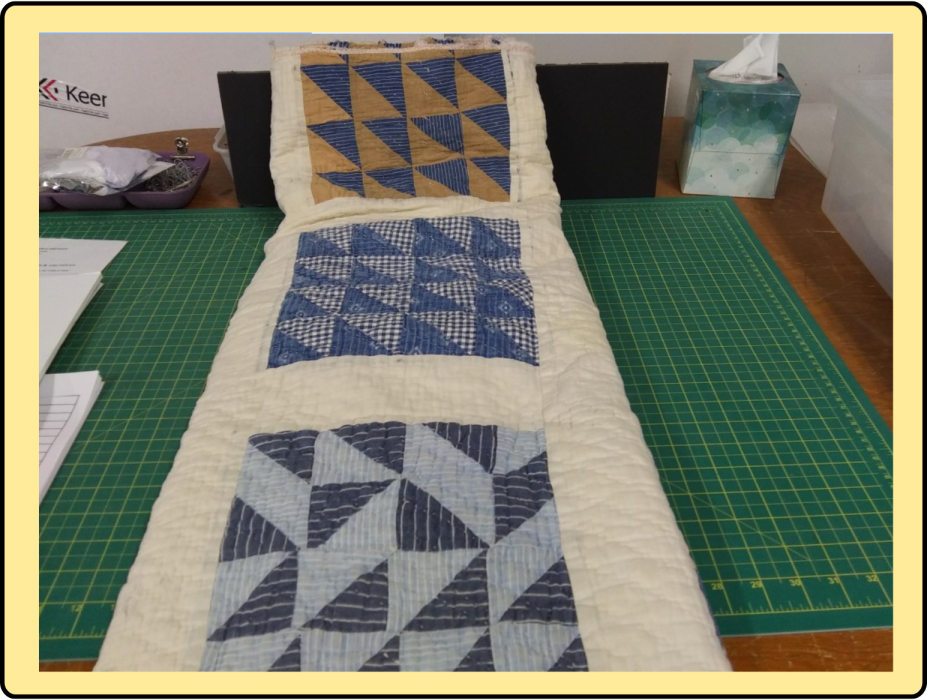
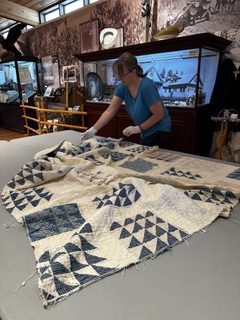
Editor’s note: The Burr Wedding Quilt was donated to the Princeton Museum in late November 2023. This is the story of how Solitaire Steele, a museum volunteer, examined the quilt and then researched to identify the likely dates it was sewn.
Burr Wedding Quilt, c. 1870 to 1903
By S. Steele
Imagine my delight at being shown such an old quilt and having the honour of trying to date it.
Trying to find a date for such an old item tends to be a series of assumptions based on a few clues, and some information on quilts of various eras.
My first clue was a flour sack, which was part of the backing on the quilt. Most flour sacks have the printing bleached out for use in quilts or dresses, but this one sack had the full logo.
Lake of the Woods Milling Company Ltd., Keewatin, which was a flagship mill. This mill produced the “Five Roses” and “Harvest Queen” flour that our ancestors would remember very well. It operated from 1887 to 1967, and was possibly the largest flour mill in the British Commonwealth at the height of its production. It was purchased by the Ogilvie Flour Mill and destroyed in a fire in 1967, never to be rebuilt.
I found a photo of the logo stating the mill was founded in May 1903, but Keewatin was replaced with the word Canada, as there were now several mills. Going with the assumption that this bag had an earlier logo on it, which was then changed in 1903, I used that date as the latest the quilt backing could possibly have been made.
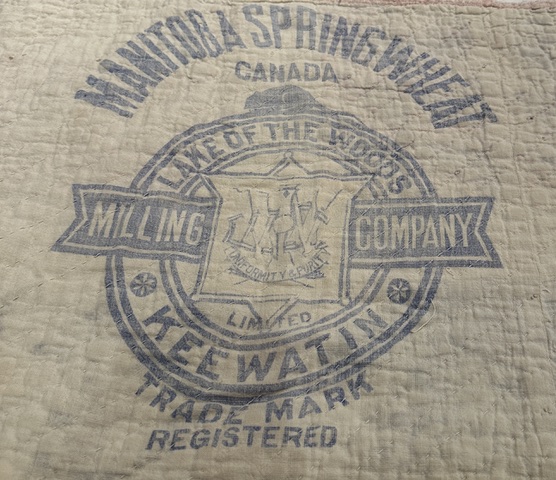
The weight on the bag – 49 lbs, also confirmed that it was an older bag, as sizes were standardized during WWII.
Then I looked at the construction of the quilt, it was machine pieced but hand quilted. Quilts were often machine-pieced from the 1860’s. The blocks are half triangles, often called “Triangle Tiles” or “Ann and Andy” back in the 1840’s and 1850’s. The batting appears to be thin cotton but, as it is old, it is hard to tell what it may have looked like originally or whether it was hand made.
As per information found in my resource – Dating Fabrics, A color guide 1800-1960, Eileen Jahnke Trestain states that in the era of 1860 – 1880, quilts had tended to have geometric piecing such as this one, and indigo and white quilts were popular, batting was thin and the use of shirting material was common. Quilts tended to have blocks of a single pattern.
From 1880 to 1910, quilts were darker overall, with a dark background, and a wider sashing between blocks. Geometric shapes were still used, as well as larger-scale blocks. Indigo prints were still in use, and the use of shirting material continued. Homespun fabrics were also common, and were often better than store bought fabric, which were notorious for being thin during this time frame and for seams to pull apart. Checks, plaids, and stripes were popular.
This quilt has mainly indigo blue triangle tiles with plain flour sack backgrounds and normal sized sashing between blocks. These blocks do differ slightly in pattern and we are not sure if this was intentional or an error, but most are made very well.
Other blocks appear to have been added, and in different colours, in check and stripes. These blocks are not so well made, points are missing and they look sloppy compared to the indigo blocks. These blocks have not stood the test of time as well as the indigo blocks, some fabric is missing and some blocks are in very poor condition.
The binding of the quilt has consistently worn away around the whole edge of the quilt, and was a pink fabric at one time. This can be seen from the pink threads still caught in the original machine stitching.
Could it be that the quilt was started as an indigo quilt in the era of 1860-1880, and then had blocks added to it for the wedding at a later date, using fabric from the 1890s that was thin, and poorly made? I think this was the most quite likely scenario.
Or was the fabric that wore away actually much older, and that is why it did not stand the test of time? However, this is unlikely as the fabric and style do not fit earlier eras.
Several theories have been discussed as to the difference in the workmanship of the blocks – perhaps it was a gift from friends who held a quilt bee – and so different ladies with varying skills produced a block. Perhaps the indigo blocks already existed, and an unexpected wedding led to additional blocks needing to be added in a hurry, to make it an appropriate size.
Was this a quilt started by a young girl for her HopeChest, and the pink blocks were her first attempt, and she got better with time, so that indigo blocks turned out much better? Or conversely, an older lady who made the indigo blocks first, and then had to quickly produce more blocks with her eye sight failing and arthritis in her hands, and so they did not match her initial skill level. We will never know.
Regardless of who made the quilt and when, the style of the quilt does tend to lean towards the era of the 1860s to 1880s, at least from the front. It’s quite possible that some of the blocks, or the original design was started in that era. It is also quite possible that someone who grew up in that era made the quilt at a later date, sticking to what she grew up with. It is also possible that the fabric or the blocks had been handed down in the family, and were used as needed, but at a later date.
The backing of the quilt is of pieces of flour sack sewn together in one piece to cover the back of the quilt. Some pieces look older than others, and all have had the logo removed except one, which was lucky for us! I am presuming, from its condition, that it may have been the newest piece, with no time, or no inclination to bleach out the logo.
We know that the Lake of the Mills Milling company opened in 1887, making this the earliest date that the backing could have been made, or finished. However, the front of the quilts are made first, sometimes years before the backing is found and the layers stitched together. I still have a quilt in my cupboard that I started over 10 years ago!
According to Princeton, Our Valley, Edgar Elma Burr married Jenny Canter in 1899. I am presuming that this quilt was made for that wedding, either by Jenny herself – starting as a young girl, for her HopeChest, or by a group of friends or a family member. We will never know but it has been well used, and obviously well-loved, and we are grateful that it was donated to our museum.
With all this information, and presumptions I have cautiously dated the quilt as circa 1870 to circa 1903. Personally, I am leaning towards the earlier date based on the style of the quilt and the date of the wedding I think it was made for.
References
Princeton, Our Valley
Dating Fabrics, A Color Guide 1800-1960
Fantastic research Solitaire! What a great item for the Museum to hold. This was a fascinating read.